

You know who you’re talking to.
You know how they think.
And you know what you need your marketing to accomplish.
Now, what should you actually say?
What Message Will Connect? is the final question in our Five Questions Every Growing Business Should Answer series.
It’s tempting to start with what you want people to know about your business. Your experience. Your services. Your process. What makes you different.
But a strong marketing message starts with what your customer needs to hear.
Sometimes they need to know you understand the problem they’re facing. Sometimes they need to understand how you can help. And sometimes they need a reason to trust that you can deliver.
That’s where the MP3 Model comes in.
Developed by content marketing strategist Erica Schneider, the MP3 Model focuses on three ways to shape your marketing message: Problem, Process, and Proof.
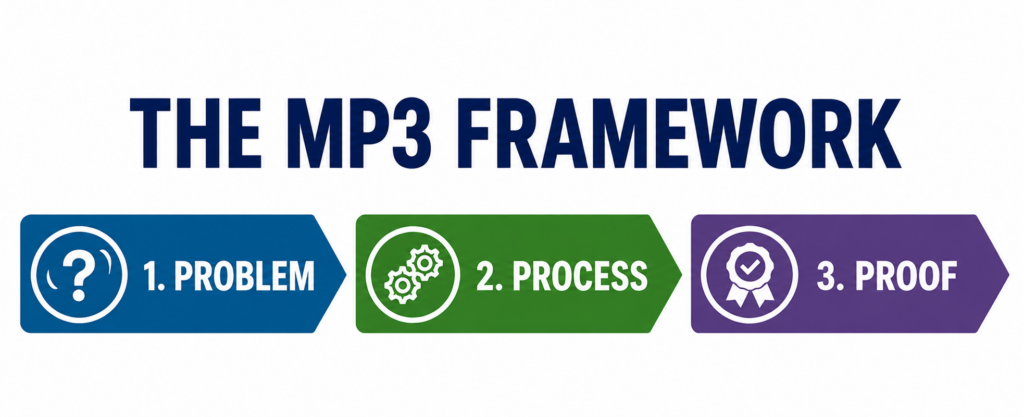
The MP3 Model: Three Ways to Shape Your Message
Your marketing doesn’t need to say everything about your business at once.
Instead, it can focus on one of three things:
- Problem: What is your customer dealing with?
- Process: How do you help solve it?
- Proof: Why should they believe you?
The right one depends on the customer, where they are in their decision, and what that particular piece of marketing needs to accomplish.
Problem: Show That You Understand
Problem-focused marketing starts with what your customer is experiencing.
What are they struggling with? What isn’t working? What are they trying to change?
The goal isn’t to make the problem sound bigger than it is. It’s to show your customer that you understand what they’re dealing with.
Process: Show How You Can Help
Once your customer recognizes the problem, they may want to know what happens next.
How do you solve it? What can they expect?
Process-focused marketing can explain your approach, answer common questions, or walk customers through the next steps.
The goal is to make how you help clear and easy to understand.
Proof: Give Them a Reason to Trust You
You can tell people you’re good at what you do. Proof gives them a reason to believe it.
Reviews, testimonials, results, case studies, and examples of your work can all help build confidence.
Proof-focused marketing answers a simple question:
“Why should I trust you?”
Which Message Does Your Marketing Need?
The right message depends on what your customer needs right now.
Ask yourself:
- Who are you talking to?
- How are they thinking?
- What does your marketing need to do?
Someone recognizing a need may connect with problem-focused messaging. Someone exploring options may benefit from process-focused messaging. And someone ready to choose may be looking for proof that builds trust.
The message should fit the moment.
Make the Message Matter
You don’t need to say everything at once. You need to say what matters in that moment.
Whether you’re addressing a problem, explaining your process, or sharing proof, the goal is the same: give your customer a reason to connect.